History of the Friends
The story of Gillespie County’s country schools is woven into the history of rural life, education, and community in the Texas Hill Country. This page brings together the history of The Friends, the county’s early school system, the country schools trail, and the dedication of the commemorative plaque honoring this heritage.
History Highlights
- The Friends was formed to preserve Gillespie County’s historic country schools.
- Gillespie County once included 44 rural school districts.
- The Country Schools Trail connects historic school sites across the county.
- A historic marker commemorates the region’s public school heritage.
Select any section below to explore the history of The Friends, the country schools, the driving trail, and the dedication of the historical marker.
The Friends of Gillespie County Country Schools was formed to preserve Gillespie County’s historic rural schoolhouses and the community traditions connected to them.
From Rural Schools to Community Centers: A Successful Preservation Effort
Although it ultimately proved unfounded, the rumor that “they’re selling our schools” brought together a group of Gillespie County citizens who organized as The Friends of Gillespie County Country Schools (FoGCCS). More than 400 members united around a common purpose: preserving the county’s 12 rural school properties, along with the traditions, community clubs, and local history connected to them.
Following the passage of the Gilmer-Aikin Law in 1949, ownership of most rural school properties in Gillespie County was transferred to the Fredericksburg Independent School District. After school consolidation, community clubs leased the former school properties, but it became clear that leasing was not a permanent solution to concerns about the long-term future of these historic places.
Research soon revealed the only lasting answer: change the law.
Because existing law prevented the school district from returning the properties to the original communities, FoGCCS began working with state leaders to pursue a legislative solution. In the spring of 2000, at the request of FoGCCS, Fredericksburg ISD sent a letter to Senator Jeff Wentworth and Representative Harvey Hilderbran asking that legislation be introduced to allow the donation of these properties to a governmental or nonprofit organization at no cost.
That effort resulted in Senate Bill 116, passed during the 77th Texas Legislature, signed by the Governor, and placed before Texas voters as a constitutional proposition. The measure was approved by 80.45% of voters, and the law took effect on January 1, 2002.
FoGCCS then launched a wide-ranging grassroots campaign to build support locally and across Texas. Their efforts included exhibits at banks, stores, the Gillespie County Fair, and Texas Preservation Day 2001. Members also published articles about rural education and Gillespie County’s 44 school districts, reaching both local and statewide audiences.
One of the group’s most successful outreach efforts was a 2001 calendar featuring the 12 historic schools, which sold more than 2,000 copies. The story of the schools was also shared through print, radio, television, and the internet. Members testified before the Texas House and Senate in support of Senate Bill 116, mailed more than 5,000 postcards, distributed flyers on Main Street, and sent information packets to every county historical commission in Texas.
FoGCCS also traveled more than 1,000 miles to participate in 10 parades with its memorable Rural School Float, depicting a rural school in the early 1900s. The float featured children and a teacher in period costume, along with community members playing Texas 42, helping bring the story of the schools to life.
A major milestone came in September 2001 with the 12 Country Schools Open House and Reunion, which included a barbecue meal cooked on one of the original school barbecue pits. The event celebrated the school’s heritage and helped build momentum for preservation.
In 2003, FoGCCS published a second calendar documenting 12 additional schools in Gillespie County. Beginning on April 5, 2003, and continuing on the first Saturday in April each year, an Open House has been held as part of the organization’s ongoing fundraising and educational efforts.
The work of FoGCCS stands as a strong example of what a grassroots preservation movement can accomplish. Although the original goal set in May 1999 was achieved, the larger preservation effort was only beginning.
FoGCCS received preservation awards from the Texas Historical Commission and Preservation Texas during Texas Preservation Day in Abilene in 2002.
In 2004, FoGCCS officially became a 501(c)(3) nonprofit organization and continued its efforts to raise funds to improve, renovate, and preserve the 12 historic properties. Priority projects included updating restroom facilities and bringing water service to seven of the 12 sites.
In January 2005, the Texas Historical Commission approved and forwarded FoGCCS’s application to place the 12 properties on the National Register of Historic Places.
In April 2006, during the organization’s annual celebration, Larry Oaks of the Texas Historical Commission presented National Register plaques to representatives of the 12 former schools and officially opened the Gillespie County Country Schools Trail, the first of its kind in Texas.
In December 2006, the Gillespie County Historical Society recognized FoGCCS’s work by presenting the organization with the Star of Texas Award.
History of Education in Gillespie County
The story of education in Gillespie County reflects the county's rural heritage, German settlement, and strong tradition of community life. The schools represented by The Friends of Gillespie County Country Schools preserve an important part of that history.
The information provided for each school refers to the existing structures on the property today. In some cases, earlier school buildings were lost to floods, replaced as enrollment grew, or rebuilt over time. As a result, the original or first school for a community may have been built earlier than the date associated with the current structure.
For those interested in a deeper study of these sites, the Gillespie County School Histories book remains a valuable source of historical detail for each property.
Selected Historic School Sites
The following schools are part of The Friends of Gillespie County Country Schools:
- Cave Creek — Built in 1881. Consolidated in 1950.
- Cherry Spring — Built in 1885. Pavilion built in 1935. Consolidated in 1972.
- Crabapple — Built in 1882. The Teacherage was built in 1878. Consolidated in 1957.
- Lower South Grape Creek — Built in 1901. Consolidated in 1960.
- Luckenbach — Built in 1881. Consolidated in 1964.
- Meusebach Creek — Built in the 1930s. This was the fourth school building for the Meusebach Creek community. Consolidated in 1953.
- Nebgen — Built in 1936. Consolidated in 1949.
- Pecan Creek — Built in 1916. Consolidated in 1955.
- Rheingold — Built in 1900. The original building dates to the 1880s, and the Teacherage was built in 1891 and consolidated in 1949.
- Williams Creek (Albert) — Built in 1897. Consolidated in 1950. President Lyndon B. Johnson attended this school.
- Willow City — Built in 1905. This was the third school building for the Willow City community and the first rural Gillespie County school to have a bus and bus shed. Consolidated in 1961.
- Wrede — Built in 1896. Consolidated in 1960.
44 School Districts in Gillespie County
(Taken from the 1892 school district map)
Big Flat
Cain City
Cave Creek*
Cherry Mountain*
Cherry Spring*
Crabapple*
Doss
Eckert (Nebo)
Flat Rock
Fredericksburg
Grape Hill
Grapetown
Harper
Hayden
Junction
Klein Branch
Klein Frankreich
Knopp
Live Oak
Lower South Grape Creek*
Luckenbach*
Meusebach Creek*
Morris Ranch*
Nebgen*
Onion Creek
Palo Alto
Pecan Creek*
Pedernales
Pilot Knob
Rheingold*
Rocky Hill
Stonewall
Squaw Creek
Tivydale
White Oak
Williams Creek (Albert)*
Willow City*
Wolf Creek
Wrede*
Young's Chapel
* Thirteen of these historic schools are listed on the National Register of Historic Places. According to Bob Brinkman of the Texas Historical Commission, Gillespie County has more listed rural schools than any other county in Texas.
Early Education in Gillespie County
As many as 44 rural schools once operated in and around Fredericksburg, the county seat of Gillespie County, during the late 19th and early 20th centuries.
German immigrants began settling in the Texas Hill Country in the mid-1800s, beginning with New Braunfels in 1845 and Fredericksburg in 1846. These settlers brought with them a deep respect for education and community life.
The first school in Fredericksburg was erected in 1847 in the Marketplatz (Market Square) at the center of town. Known as the Vereins Kirche (Community Church), it served multiple roles—as a church, school, community meeting hall, and even a fort if needed. At that time, the area was still very much frontier country, and Comanche Indians were active in the region.
As families settled farther from Fredericksburg, early rural education often began with a teacher instructing children in a private home. Over time, land was donated within local communities, and schoolhouses were built. Many of these schools were named for nearby natural features, such as Cave Creek, Crabapple, Pecan Creek, and Lower South Grape Creek. Others reflected the county's German heritage, including Luckenbach, Meusebach Creek, Rheingold, and Nebgen.
Several of the schools now preserved by The Friends date to the 1870s and 1880s. The original Rheingold School is considered the oldest rural school in Gillespie County.
School Life and Traditions
Many rural schools in Gillespie County offered instruction in both German and English, reflecting the region's bilingual culture.
The end of the school year was often celebrated with an all-day event called the Schulprüfung ("school examination"), during which students demonstrated what they had learned before family and friends. These events were often followed by a picnic and dancing that continued into the evening.
Several schools still preserve pieces of that early school culture:
- Four schools still display their original school-closing curtains, decorated with advertisements for early Gillespie County merchants
- Three schools still contain their original student desks and the teacher's desk
These details offer a rare glimpse into the daily life of rural students and teachers in the Texas Hill Country.
The End of the Rural School Era
The passage of the Gilmer-Aikin Law in 1949 led to the consolidation of most rural schools in Texas, bringing this chapter of public education to a close.
Some former school buildings were eventually adapted as private residences, while others were preserved as historic interpretive sites.
One example is White Oak School, which was moved to the Pioneer Museum Complex at 309 West Main Street in Fredericksburg. There, visitors can step inside a preserved rural schoolhouse complete with desks and the teacher's bell.
Another is the Junction School, located within the LBJ National Historical Park in Stonewall. The one-room schoolhouse is part of the park's interpretive program and is especially notable because President Lyndon Baines Johnson attended it at age four.
Beginning in the 1950s, local community clubs organized to care for several former rural school properties using their own funds, even though the properties remained owned by the Fredericksburg Independent School District (FISD).
That strong sense of community continues today. Fourteen former school properties remain in use as community centers, social gathering halls, polling places, and event venues. Many are available for rental and continue to serve the communities that once gathered there for education.
Historic Places on the Gillespie County Country Schools Trail
The Gillespie County Country Schools Trail connects historic school sites across the county, giving visitors a unique opportunity to experience the region’s educational heritage firsthand.
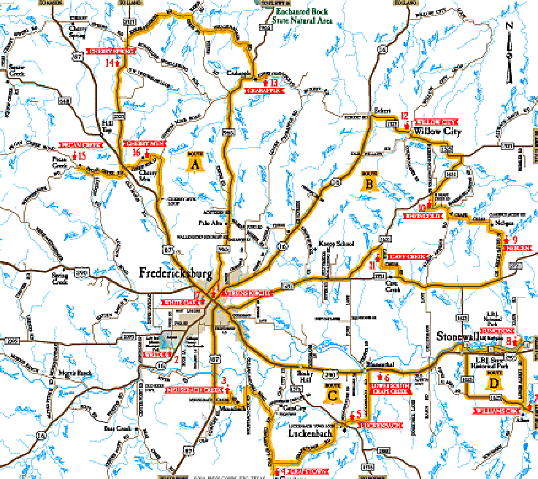
Gillespie County Country Schools Trail Map (color-coded routes across the county)
On January 23, 2006, the Gillespie County Commissioners Court officially established the Gillespie County Country Schools Trail, linking 16 historic country school sites along with the Vereins Kirche (Community Church)—a replica of the first school in Gillespie County, located on Market Square in Fredericksburg.
The trail is the first of its kind in Texas, and possibly in the nation.
On April 1, 2006, State Representative Carter Casteel (District 73) presented The Friends with a signed resolution from the Texas House of Representatives, recognizing both the creation of the trail and the ongoing efforts to preserve these historic school properties. These efforts also contributed to the schools’ placement on the National Register of Historic Places.
The trail is sponsored by The Friends of Gillespie County Country Schools in cooperation with the Gillespie County Historical Society, the LBJ National and State Park, the Cherry Mountain Community Club, and the Grapetown Community Club. Together, these organizations support the trail and its related activities throughout the year.
The purpose of the trail is to:
- preserve and share the history of public education in Gillespie County
- document the more than 40 rural school districts that once existed—many now largely forgotten
- Highlight the remaining school buildings and their role in community life
As part of this effort, a permanent display at Market Square in Fredericksburg was completed and dedicated on April 10, 2009, providing visitors with an overview of the county’s school districts and historic sites.
The Country Schools Trail offers visitors a chance to:
- learn about rural education and daily life in the 19th-century German Hill Country
- explore a variety of historic schoolhouse designs and architectural styles
- Experience the scenic beauty of Gillespie County, especially during the spring wildflower season.
The approximately 120-mile trail is divided into color-coded routes that guide visitors through different areas of the county. A visit can range from a couple of hours to a half-day excursion, depending on how many sites are explored.
A Driving Trail Brochure is available to help visitors navigate the routes and plan their trip.
Detailed information about each of the 16 schools is available in the Schools section of this website. One site, White Oak School, located within the Pioneer Museum complex in Fredericksburg, is open daily. During the annual Open House weekend—held the first weekend in April—several additional schools are open to the public.
Today, these historic school buildings continue to serve the community as event spaces and gathering places, and many are available for rental. Hosting an event at one of these sites offers a unique way to experience Gillespie County history.
Color-coded trail maps are available throughout Fredericksburg, including:
- the Visitor Center (302 E. Austin Street)
- the Up-Town Visitor Center on East Main Street
- the Vereins Kirche (Community Church)
- and at individual school locations
Visitors can also explore interpretive information at each site, including details about:
- early school customs
- transportation
- school lunches
- discipline
- outhouses and wells
- teacher salaries
These stories help bring to life the daily experiences of students and teachers in Gillespie County’s early rural schools.
Historic Marker Commemorating Gillespie County’s Public School History
On April 4, 2009, The Friends of Gillespie County Country Schools (FoGCCS) dedicated a historic marker at the Vereins Kirche (Community Church), located at Market Square, 112 W. Main Street, Fredericksburg, Texas, to commemorate Gillespie County’s rich public school history.
The marker was installed in the area directly behind the Vereins Kirche, a location chosen not only for its visibility but also to honor the site of the county’s first public school, established there in 1847.
About the Marker
The marker features a map documenting:
- 42 rural public school districts
- the Harper and Fredericksburg districts
- the locations of historic schoolhouses
- and the number of teachers and grade levels recorded at the time of the census
This map was prepared as a county school census and is believed to be the only known documentation showing all school districts in Gillespie County in one place. Although the map is not dated, it is believed to have been created sometime in the 1920s or 1930s.
The marker also highlights the Gillespie County Country Schools Trail, established in 2006, which is believed to be the only trail of its kind in the nation.
Honoring a Long Educational Tradition
Public education was promised to early settlers by the Adelsverein—the Society for the Protection of German Immigrants in Texas—and that promise was fulfilled with the opening of the first public school in the Vereins Kirche in 1847.
The Texas Public Schools Act of 1854 encouraged the establishment of rural schools throughout the state. It supported the formation of school districts in Gillespie County, where the strong German heritage placed a particular emphasis on education.
The rural public school era gradually came to a close following school consolidation under the Gilmer-Aiken Act, when the last country schools were absorbed into the Fredericksburg Independent School District.
Today, Gillespie County is served by three public school districts:
- Doss
- Fredericksburg
- Harper
For a complete listing of the historic school districts, visitors are encouraged to explore the School History section of this website.
Dedication Ceremony
The dedication ceremony was held in the Oktoberfest Hall at Market Square and was followed by the official unveiling of the marker.
Former teachers and students from the rural schools were recognized during the event and invited to register for the event. Members of the public were also welcome to attend and enjoy refreshments.
The dedication was part of the 10th Annual Country School Open House, one of FoGCCS’s continuing efforts to preserve and celebrate Gillespie County’s rural school heritage.
Following the ceremony, open houses were held at:
- Grapetown
- Lower South Grape Creek
- Luckenbach
- Meusebach Creek
- Williams Creek (Albert)
Acknowledgment
FoGCCS extends special thanks to Kathy Harrison and the Hill Country Education Foundation, whose support played a major role in making this project possible.